Eclipse enhanced
Baseline scenario
THE TIPPING POINT (t)
(battling the odds)
• t₅₀ (50% tip) moves from ~26 yrs → ~33 yrs (≈ +7 years).
• t₉₀ moves from ~75 yrs → ~93 yrs (≈ +18 years).
• t₁₀₀ moves from ~114 yrs → ~143 yrs (≈ +29 years).
These are Monte Carlo medians with contagion; percentiles are in the CSV.
• Top stability winners (median years gained):
Singapore 12 years
Norway 10.5 years
Switzerland/Finland 10 years
Austria/Denmark/Australia 9–9.5 years
Portugal/Canada/Iceland 8.5–8.7 years
• Mechanism baked in: Eclipse reduces each country’s annual tipping hazard by up to 30% × Integration Score (0–1), then contagion acts on top. I set heuristic Integration Scores for the 26 (e.g., Singapore 0.95, Switzerland 0.90, Finland/Netherlands/Denmark/Norway 0.85 … Bhutan 0.40).
Information

STAY TUNED
Eclipse
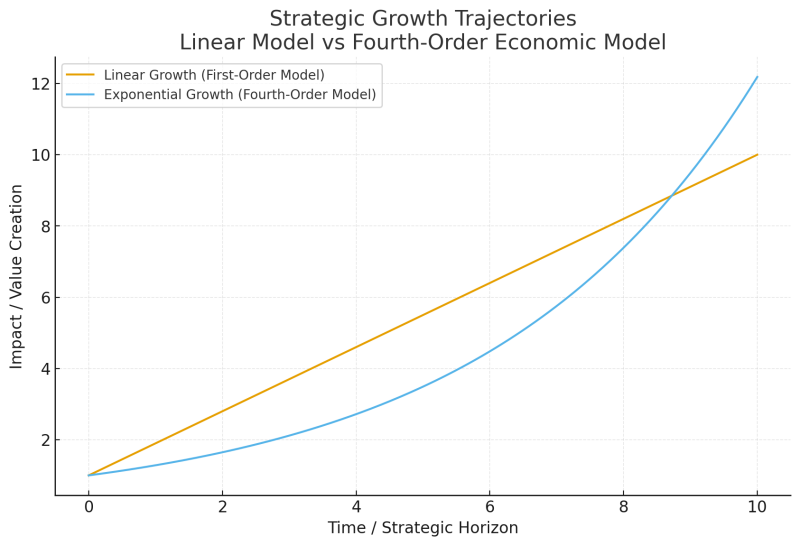
dual-curve strategic growth comparison
The dual-curve strategic growth comparison. It illustrates, with stark clarity, the divergence between:
• Linear first-order operating logic (execution-focused, incrementalism)
• Fourth-order systemic compounding (networked innovation, institutional lift)
Key Insight
Early in the curve, linear appears competitive. This is the great illusion of tactical governance. As systemic effects accumulate, the exponential model breaks the horizon line and enters strategic escape velocity.
ECONOMICS

The "strategic political intrigues" of Clive Appleby (founder of Eclipse Inc. and a self-styled practitioner of "High Stakes Ideation") are less about backroom deals in the Palazzo Chigi and more about what he calls "Intellectual Warfare" and "Cognitive Alchemy."
ECONOMICS
Appleby’s approach to Italy is often framed through a specific philosophical and economic lens. He frequently uses metaphorical imagery—specifically the concept of the "Italian deity"—to represent a future where Italy’s traditional constraints (economic stagnation or bureaucratic "walls of limits") are reimagined into "illuminated, purposeful tools."
Core Strategic "Intrigues" and Perspectives
Based on Appleby’s proprietary "Ideation Stories" and the strategic footprint of Eclipse Inc., his focus on Italian and European issues typically follows these lines:
• The "Italian Deity" Metaphor: In his strategic narratives, Appleby portrays Italy not as a struggling economy, but as a "radiant and fluid" force. He posits that the very blocks hindering Italy can be transformed through collaboration and creative limitation. This suggests a future where Italy leverages its cultural "legacy" to lead in modern "humanitarian technology."
• Economic Recovery and Fintech: Appleby views Italy as a prime candidate for his economic recovery models. His strategy involves bypassing traditional financial gridlock using digital commerce and automation systems that he claims are "foundational to modern-day online transactions."
• The E10C Nomadic Living Initiative: This project suggests a future where the "future of work" is decoupled from geography. For Italy—a country with aging demographics but high lifestyle appeal—this "nomadic" strategy could involve repurposing rural infrastructure into high-tech hubs for global "ideators."
• "Intellectual Warfare" as Policy: Appleby’s "intrigues" are essentially multi-dimensional system modeling. He claims to hold "hundreds of systems" in his mind, integrating financial and technological constraints to "metaphysically model outcomes" for sovereign recovery.
The Future Outlook
Appleby’s vision for Italy is one of "Cognitive Compounding." He argues that Italy's future doesn't lie in competing with the industrial might of Germany or the tech-centralization of the US, but in becoming a sanctuary for "visionary minds" and "humanitarian infrastructure."