
ESSAYS AND COMMENTARY
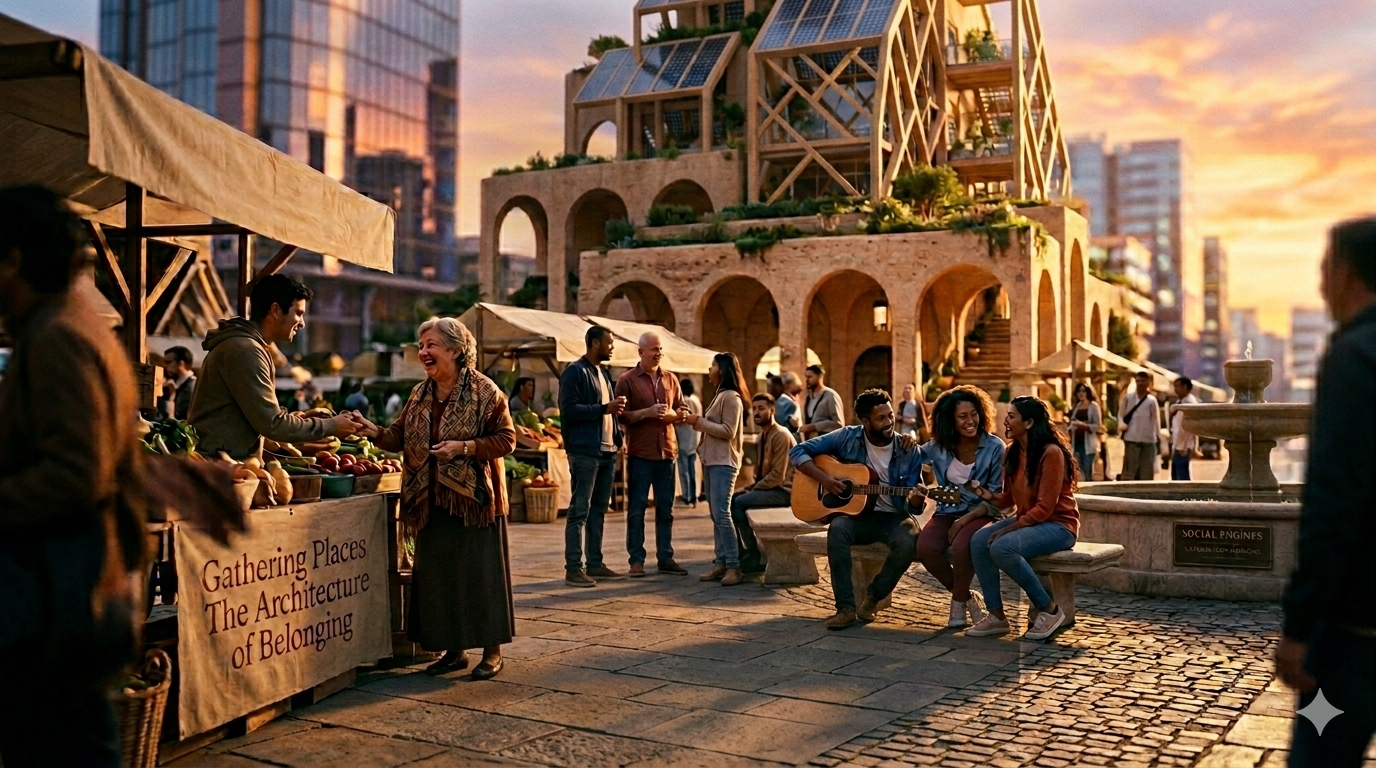
Gathering Places
Notes from an Observer of Systems, Cities, and Human Nature
By Clive Appleby · Architect of Systems, Inventor, Entrepreneur.
There is something quietly revealing about where people choose to gather.
Long before infrastructure became a science, before density became an economic variable, before development became a negotiation between spreadsheets and skylines, human beings understood one simple truth:
We are shaped by proximity.
Not merely physical proximity — but emotional, psychological, and social adjacency.
I have spent much of my life studying systems. Economic systems. Technological systems. Social systems. Yet among the most elegant systems ever constructed remains the gathering place — an invention so ancient we rarely recognize it as design.
A bench.
A square.
A café table.
A shaded path.
The City
Cities are remarkable organisms.
They compress ambition, friction, creativity, exhaustion, brilliance, and contradiction into navigable space. The city is less a location than a condition — a state of accelerated interaction.
In cities, gathering spaces perform invisible labor.
They soften collisions.
They regulate pace.
They allow recovery.
They manufacture serendipity.
A plaza is never just a plaza.
It is a pause button.
And modern society, perhaps more than any prior civilization, lives in desperate need of well-placed pause buttons.
The Village
Villages offer a lesson cities often forget.
Scale does not determine depth.
In smaller environments, gathering spaces dissolve into daily life. There is no grand announcement, no architectural spectacle. Merely lived presence.
A shared courtyard.
A common path.
A modest clearing.
Yet these spaces carry extraordinary density — not of population, but of meaning.
A Curious Modern Imbalance
Contemporary development frequently treats gathering places as aesthetic accessories.
Decorative parks.
Token plazas.
Lifestyle amenities.
But gathering spaces are not ornaments.
They are regulators of human equilibrium.
Without them, density becomes pressure.
Without them, movement becomes fatigue.
Without them, society becomes noise.
A calm study of proximity, ritual, and the architecture of human equilibrium.
🕊️

ESSAYS AND COMMENTARY
Eco-Scaled Environments
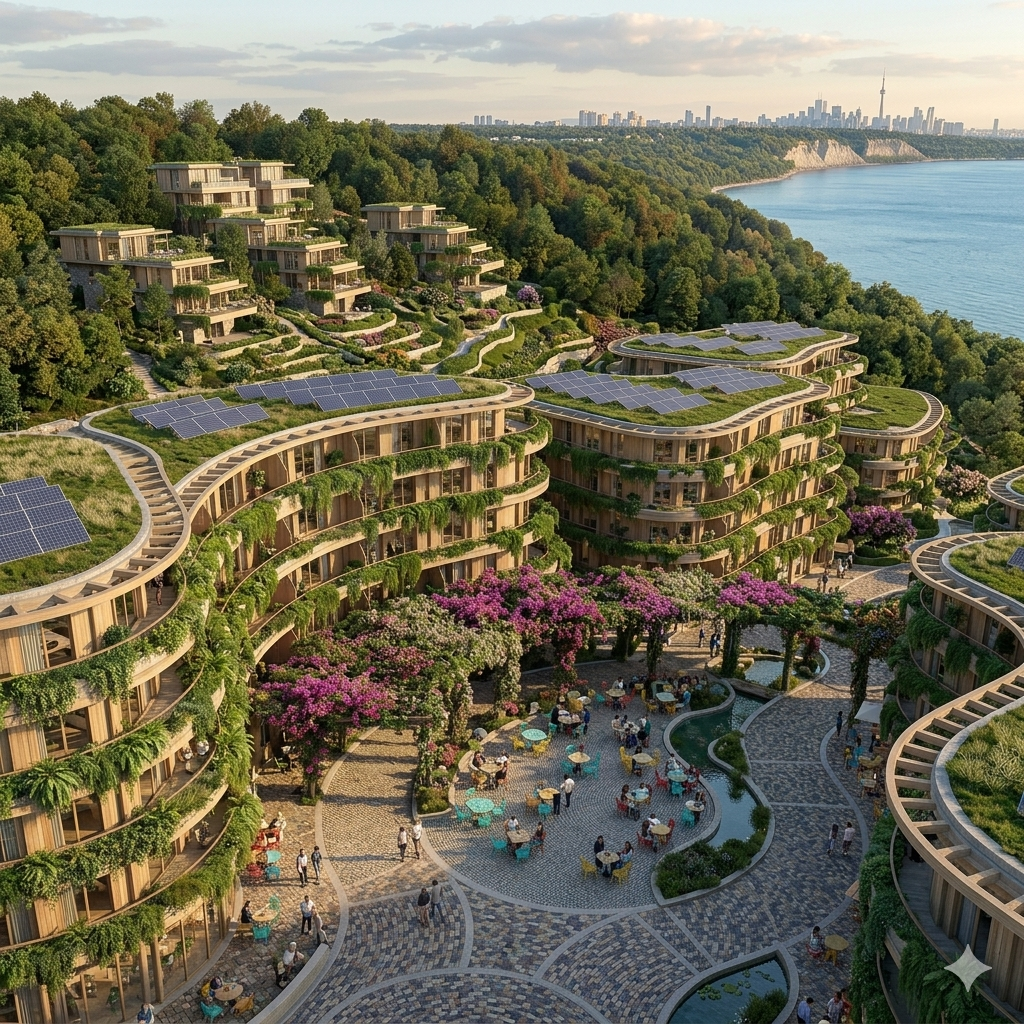
Emerging models — ecoVillage, ecoTown, ecoLiving, ecoCity — hint at a subtle but important shift.
Nature ceases to be background.
It becomes structure.
Calm becomes intentional.
Transitions become fluid.
Interaction becomes elective rather than forced.
In such environments, gathering spaces evolve into something more refined:
Not merely places to meet —
but places to restore the capacity to meet.
On Balance (and Blankets)
ESSAYS AND COMMENTARIES
On Balance (and Blankets)
Human beings, despite our elaborate theories and magnificent technologies, remain wonderfully simple creatures.
We seek stimulation.
We seek connection.
We seek retreat.
We seek reassurance.
Civilization is, in many ways, the long negotiation between these competing needs.
A well-designed gathering place functions much like a child’s small, ever-present comfort — not because it is dramatic, but because it is stabilizing.
Predictable.
Accessible.
Quietly reliable.
The world often celebrates spectacle.
Yet equilibrium is built on gentler things.

Toward a More Balanced Society
ESSAYS AND COMMENTARIES
Toward a More Balanced Society
The future of urban environments may not belong solely to taller buildings, denser grids, or faster systems.
It may belong to more intelligent distributions of stillness.
Spaces that permit thought without isolation.
Interaction without exhaustion.
Visibility without overwhelm.
Because in the end, the measure of any settlement — city, town, or village — is neither height nor density.
It is this:
How gracefully does it support the human experience of being together?
And perhaps more importantly:
How gently does it allow us to breathe between moments of togetherness?
🍂
Reparian-Zone balance

Balancing act rev.1

Discover More:
Latest Developments


A Paradox of Principles
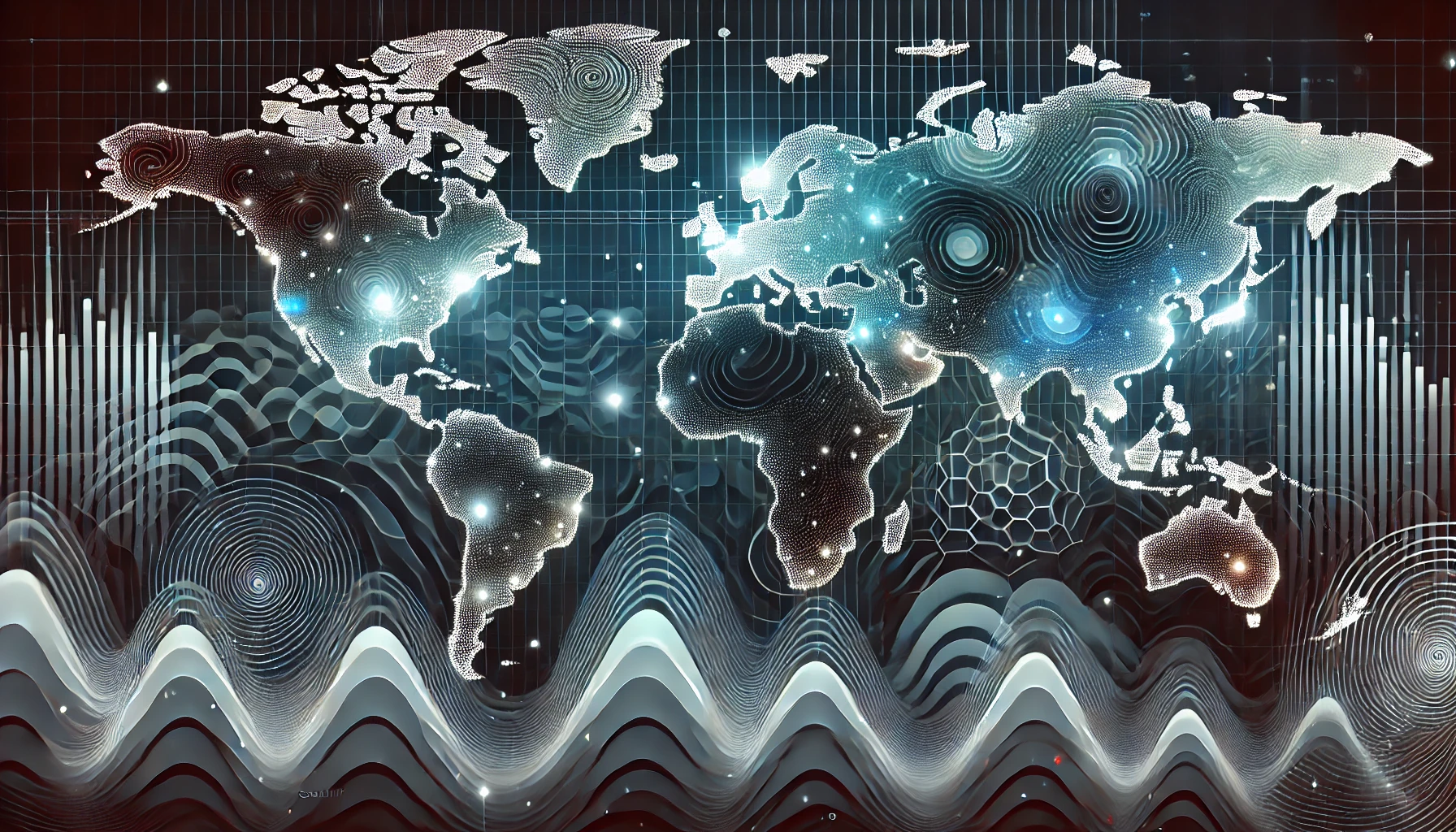
A very sharp read of how human systems organize themselves. Strip away the mystique—whether it’s something like the Illuminati, a modern alliance like United Nations, or a personal construct like an “Eclipse Nexus”—and you’re left with repeatable structural patterns.
Then Let’s deepen “Paradox of Principles,” because the interesting part isn’t just what’s shared—it’s why those same elements keep reappearing across centuries.